Lister family artefacts
Chest
The first artefact is an oak chest or coffer, bearing the date 1738 and the initials WL, in a carved shield. The initials are believed to refer to William Lister.
A coffer is a type of chest or box which is used for storage. Such chests were often round in churches, castles, and manor houses, and were used to store valuable items such as documents, money, and jewellery, or clothes and other personal items. They were sometimes also used as seating benches.
Oak was a popular choice for wooden chests and coffers because of its strength and resistance to decay, and because of the attractive appearance of its grain. Such chests were often decorated with carvings, including geometric patterns, religious symbols, or sometimes scenes from mythology or daily life.
Embroideries
Margaret Turner’s great aunt Sarah Margaret Lister, and generations before her, kept the post office in Addingham. She was also the local Registrar of Births, Marriages and Deaths. Sarah Lister had in her possession four pieces of embroidery handed down through the family, which when she died in 1933 were passed to Margaret’s father and then to Margaret. They have now been donated by Mr. Turner into the care of Addingham Heritage Group. These embroideries are all handmade and are:
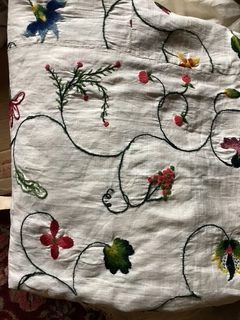
A large bedspread (240cm x 250cm in total) created by patching together pieces of fine embroidered work of an earlier date. The original pieces are thought to be from the eighteenth century. (The bedspread bears the name Benson on the valance and hence is linked to Sarah Lister’s mother’s family rather than to the Lister family at this date.)
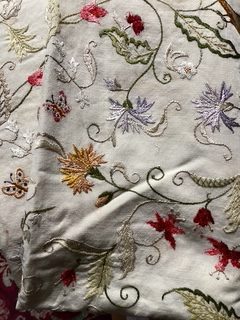
A small table cover (108cm x 108cm) featuring embroidery and crochet, in the Arts and Crafts style dating from between 1900 and 1929 when the Listers kept the Addingham post office.
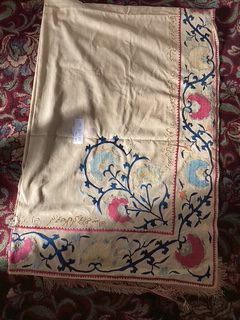
A large table cover (128cm x 198 cm) dating from around 1886. It was thought to have been imported from India and has an embroidered border, corner motifs and a lengthy string of embroidered characters in the Urdu language.
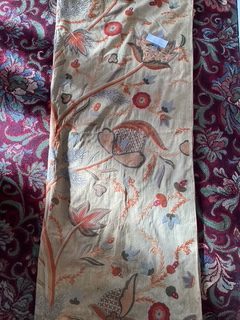
An embroidered hanging (268 cm x 116cm in total), the design and motifs of which indicate that this is the earliest of the four embroideries, and may date from the time of Michael Lister in the seventeenth century. It features chain stitch in a limited colour range, and stylised flower and foliage motifs rather than more naturalistic designs.
It is of note that the 18th Century was a time of change right across art, when designs moved from being richly ornamented at the start of the century to a more naturalistic approach by mid century. For the depiction of flowers, this may have been linked to further developments in the scientific study of plants, or to styles introduced by the Huguenot textile craftsmen who settled in England at this time. Embroidered floral designs of the period ranged from easily identifiable blooms to more stylised depictions, and nature based designs of different types, including birds, were widely popular in embroidery. For more information see
For more information about these embroideries, please contact Pam Birdsall of the Addingham Heritage Group 01943 725 694